university computervision week1 theory
Image Definition, Domain, and Range
Source:
- HC1a Images and Interpolation
- https://rvdboomgaard.github.io/ComputerVision_LectureNotes/LectureNotes/IP/Images/index.html
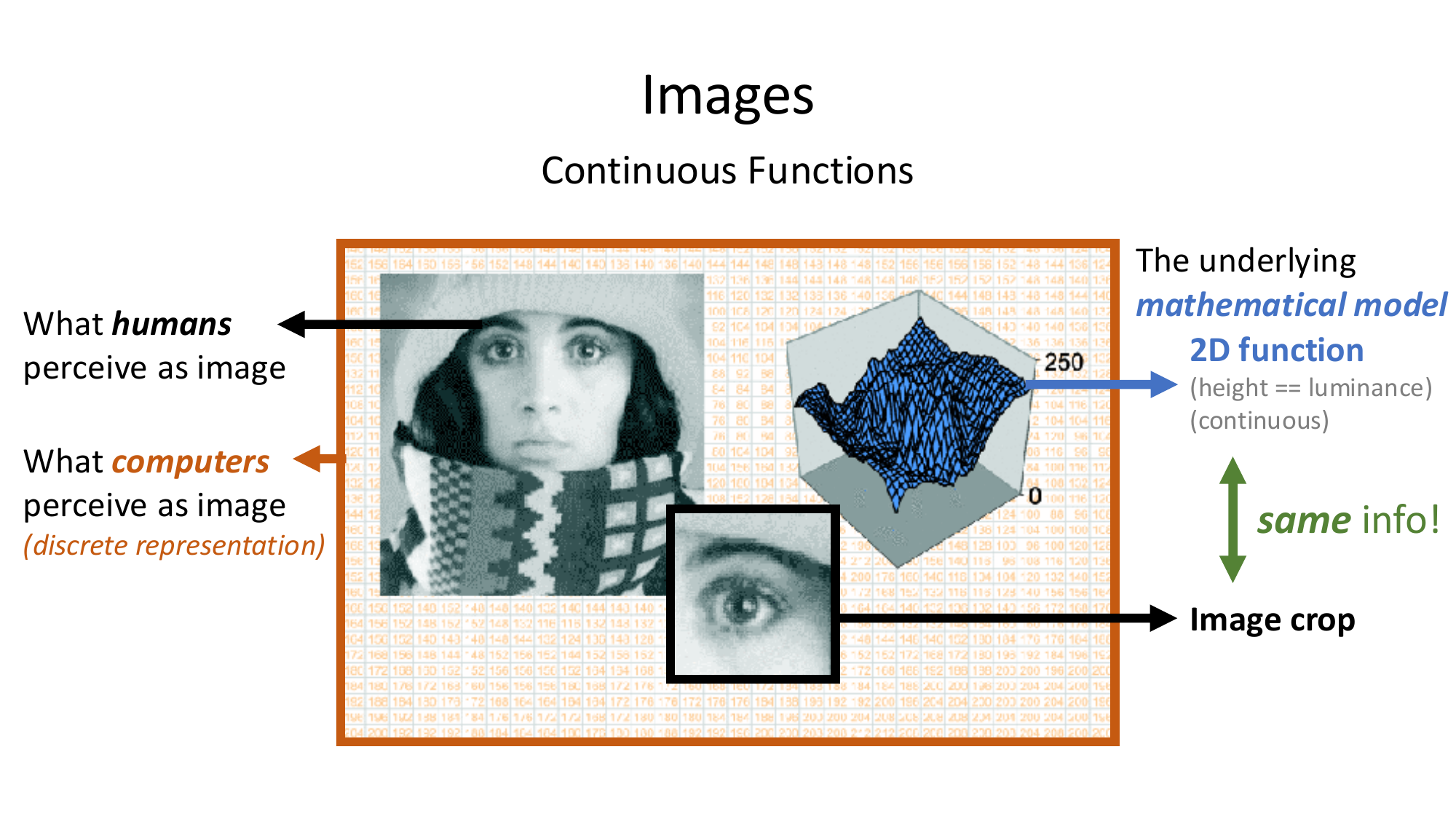
Main definition
The lecture defines an image as
This means:
- is the domain
- is the range
At every position , the image gives a value .
Domain
The domain tells you where you are measuring.
For a flat image:
So a point in the image is something like
This is just a position on the camera sensor or image plane.
The lecture notes also point out:
- for ordinary photographs,
- for scans / volumetric data,
- the coordinate frame can change while the underlying signal stays the same
Range
The range tells you what kind of value is stored at each position.
Examples:
Grayscale:
Color:
Binary image / mask:
Segmentation labels:
The handwritten notes phrase the binary case as:
- indicator image
- binary mask / segmentation
with an example such as:
0= background1= person
and note that semantic segmentation just uses more labels.
Easy way to remember it
- Domain = input = position
- Range = output = measured value
So:
Why this matters
This is the foundation for the rest of the lecture:
- If the domain becomes discrete, that is sampling
- If the range becomes discrete, that is quantization