university computervision week1 theory
What Is An Image
Source:
- HC1a Images and Interpolation
- https://rvdboomgaard.github.io/ComputerVision_LectureNotes/LectureNotes/IP/Images/index.html
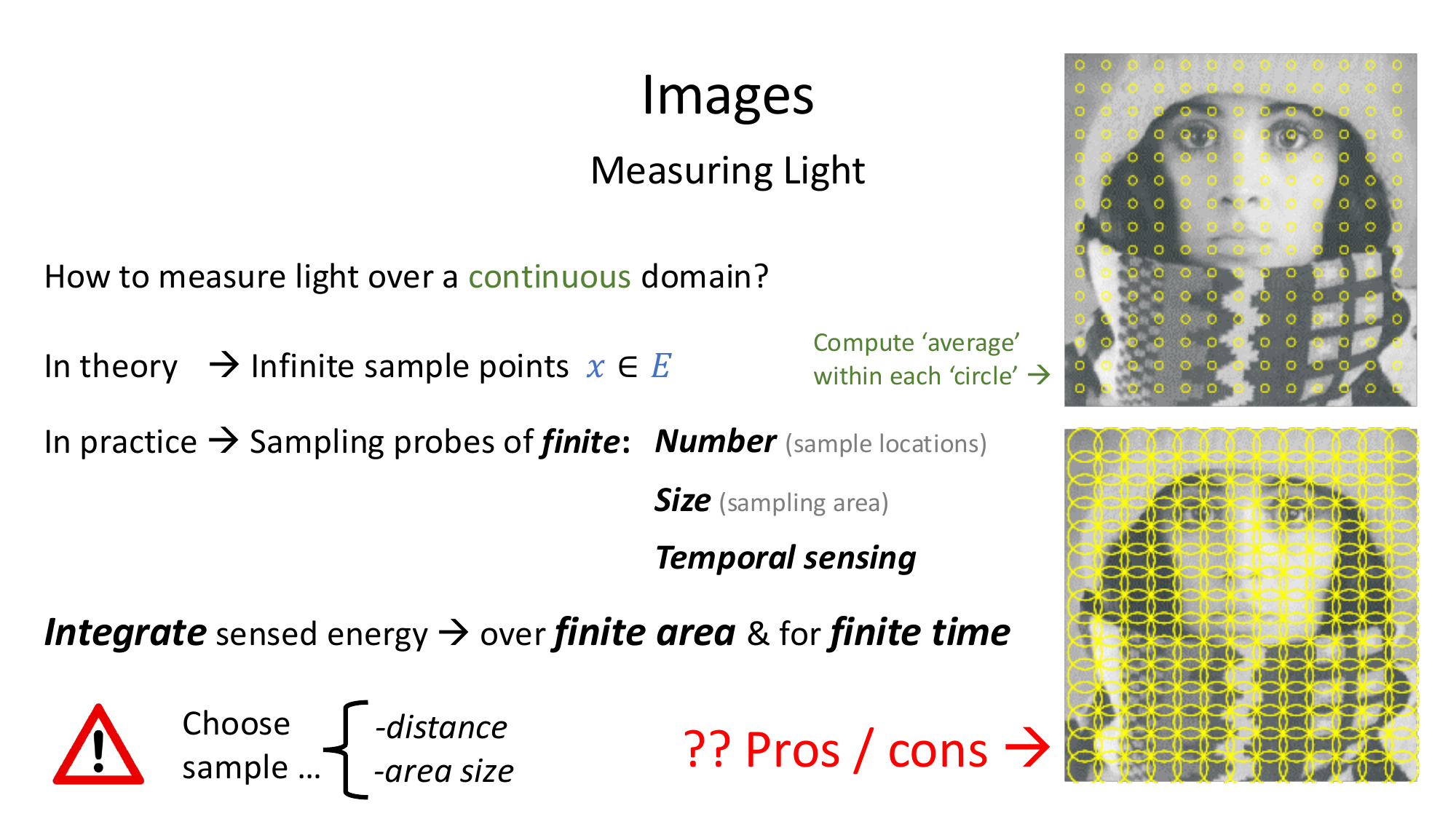
Short idea
In everyday language, an image looks like a collection of pixels.
In the lecture, the deeper idea is:
So an image is not only a grid of squares on your screen. A grid of pixels is only the stored discrete version.
Intuition
Think of a photograph as a sheet where every location has some amount of light.
- A camera measures light
- The measurement depends on position
- So we model the image as a function over space
For a grayscale image:
tells you the brightness at position .
Why the lecture says computers see images differently
Humans think:
- picture
- scene
- object
Computers store:
- numbers
- arranged on a grid
So there are really two views:
- The continuous mathematical idea
- The discrete stored image
The whole lecture is mostly about moving between these two views.
Pixels
Pixels are called the “atoms” of an image because they are the smallest stored units in the digital image.
But a pixel is not a tiny real square in nature. It is just:
- one sample location
- with one stored value
That is why zooming in too much makes an image look blocky.
The handwritten lecture notes make this explicit:
- pixels are not true rectangular image elements in the physical world
- the rectangular grid is part of the discrete representation, not part of reality