university computervision week1 theory
Quantization
Source:
- HC1a Images and Interpolation
- https://rvdboomgaard.github.io/ComputerVision_LectureNotes/LectureNotes/IP/Images/index.html
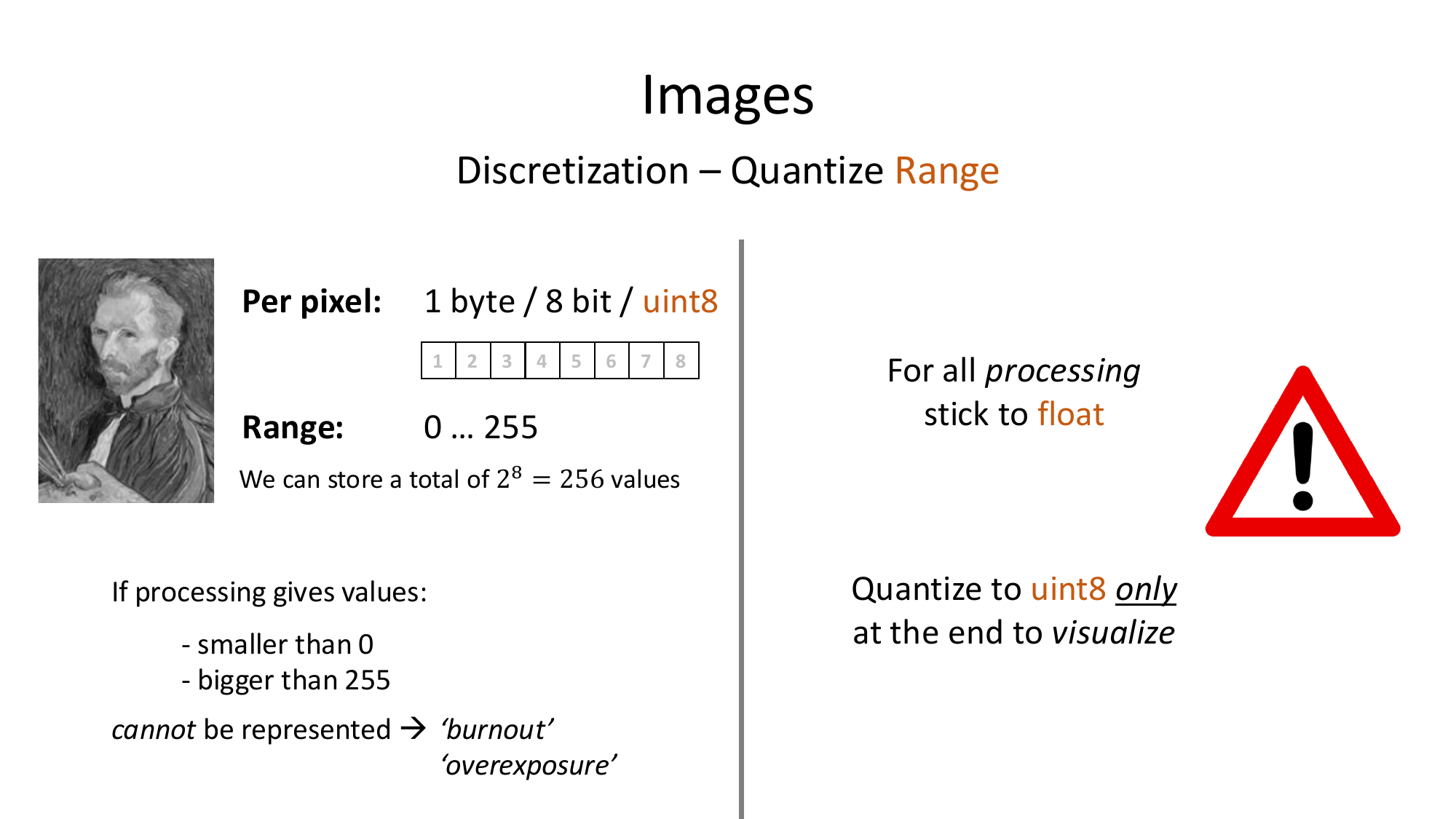
What quantization means
Quantization means:
The image intensity might be any real number in theory, but the computer stores only a finite set.
Standard grayscale case
For an 8-bit grayscale image:
That is:
possible values.
Standard color case
For RGB:
with 8 bits per channel, so:
- 1 byte for red
- 1 byte for green
- 1 byte for blue
Total:
The handwritten notes also mention that channel order depends on the framework.
For example, OpenCV often uses:
BGRinstead of RGB.
Why the lecture says “use float while processing”
During computations, values can go outside the display range:
- smaller than
- bigger than
If you keep them as uint8, bad things can happen:
- clipping
- overflow
- loss of information
So the lecture advice is:
- process in
float - convert to
uint8only when visualizing
Rescaling formula
If you want to map values in an array to the display range :
This stretches the minimum to and the maximum to .
Python
import numpy as np

f = np.array([20, 50, 120, 200], dtype=float)

g = (f - f.min()) / (f.max() - f.min()) * 255
g_uint8 = g.astype(np.uint8)

print(g)
print(g_uint8)
Why order matters
The lecture warns that
h = 255 * (f - f.min()) / (f.max() - f.min())can be dangerous if f is still uint8.
Reason:
255 * (...)may happen while values are still stored in 8 bits- numbers above 255 can overflow
So the safe idea is:
- convert to float first
- then scale
The handwritten notes explain the subtle point here:
- the formulas are mathematically equivalent
- but code runs left to right
- if multiplication happens while values are still
uint8, intermediate overflow can happen before normalization finishes
Easy intuition
Quantization is just rounding the vertical axis of the image values.
Sampling discretizes where you look. Quantization discretizes what values you can store.