university computervision week1 theory
Interpolation
Source:
- HC1a Images and Interpolation
- https://rvdboomgaard.github.io/ComputerVision_LectureNotes/LectureNotes/IP/index.html
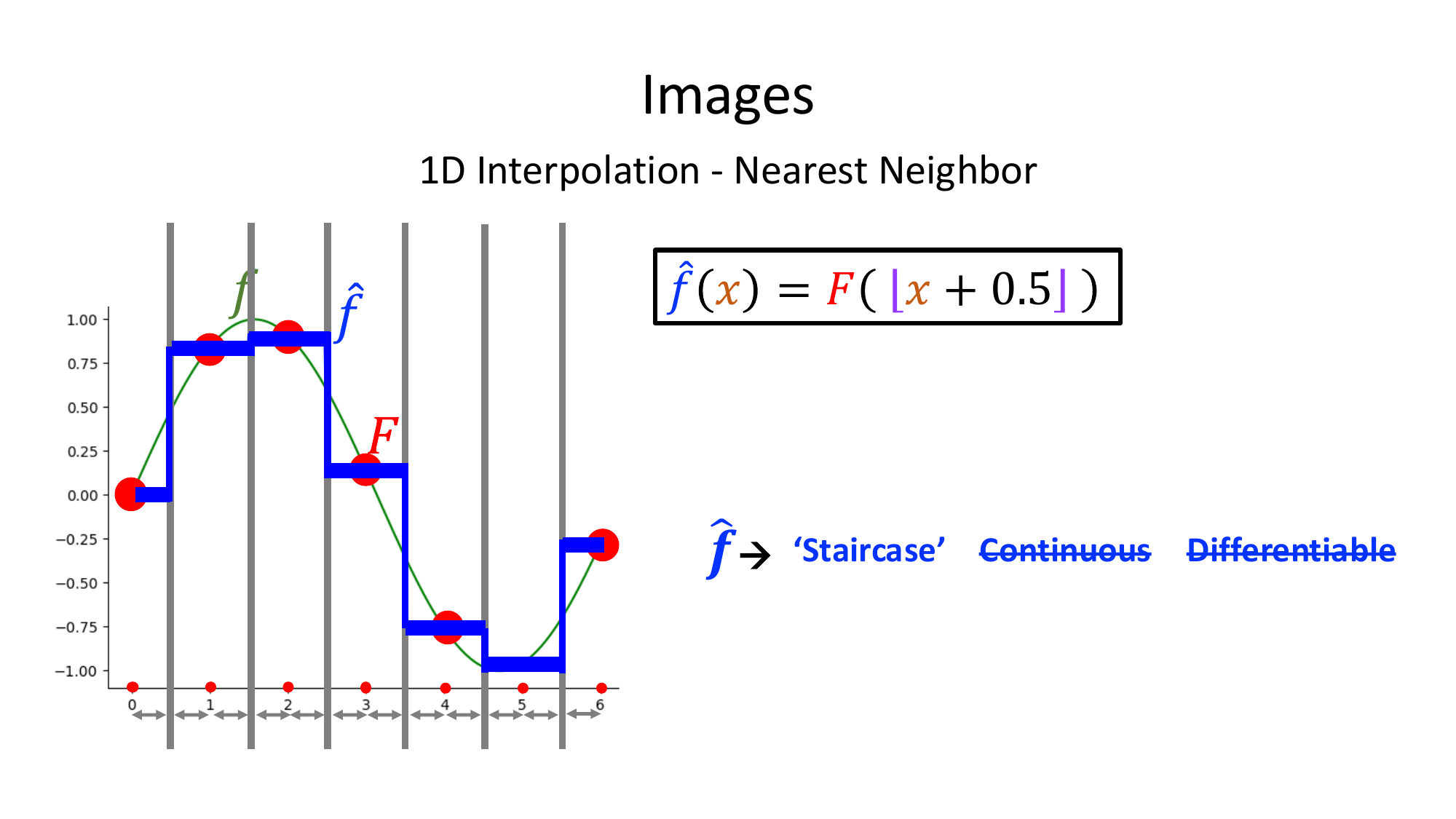
Core idea
After discretization, we only know image values on a grid:
But sometimes we want the value at a location that is not exactly on the grid:
with non-integer or .
Interpolation means:
Why we need it
Interpolation is used whenever we:
- resize an image
- rotate an image
- warp an image
- sample at non-integer coordinates
What the lecture assumes
The lecture says interpolation makes sense when the image is well sampled.
That means the discrete samples still contain enough information about the original signal.
The Remarkable notes phrase interpolation as an informed guess:
- we already lost information when going from continuous to discrete
- interpolation does not recover the true original function exactly
- it estimates reasonable values between samples
Your confusion: “why does nearest neighbor make a staircase?”
Because nearest neighbor says:
So for a whole interval of values, the output stays exactly the same.
That produces flat horizontal pieces, which look like stairs.