university computervision week1 theory
Nearest Neighbor Interpolation
Source:
- HC1a Images and Interpolation
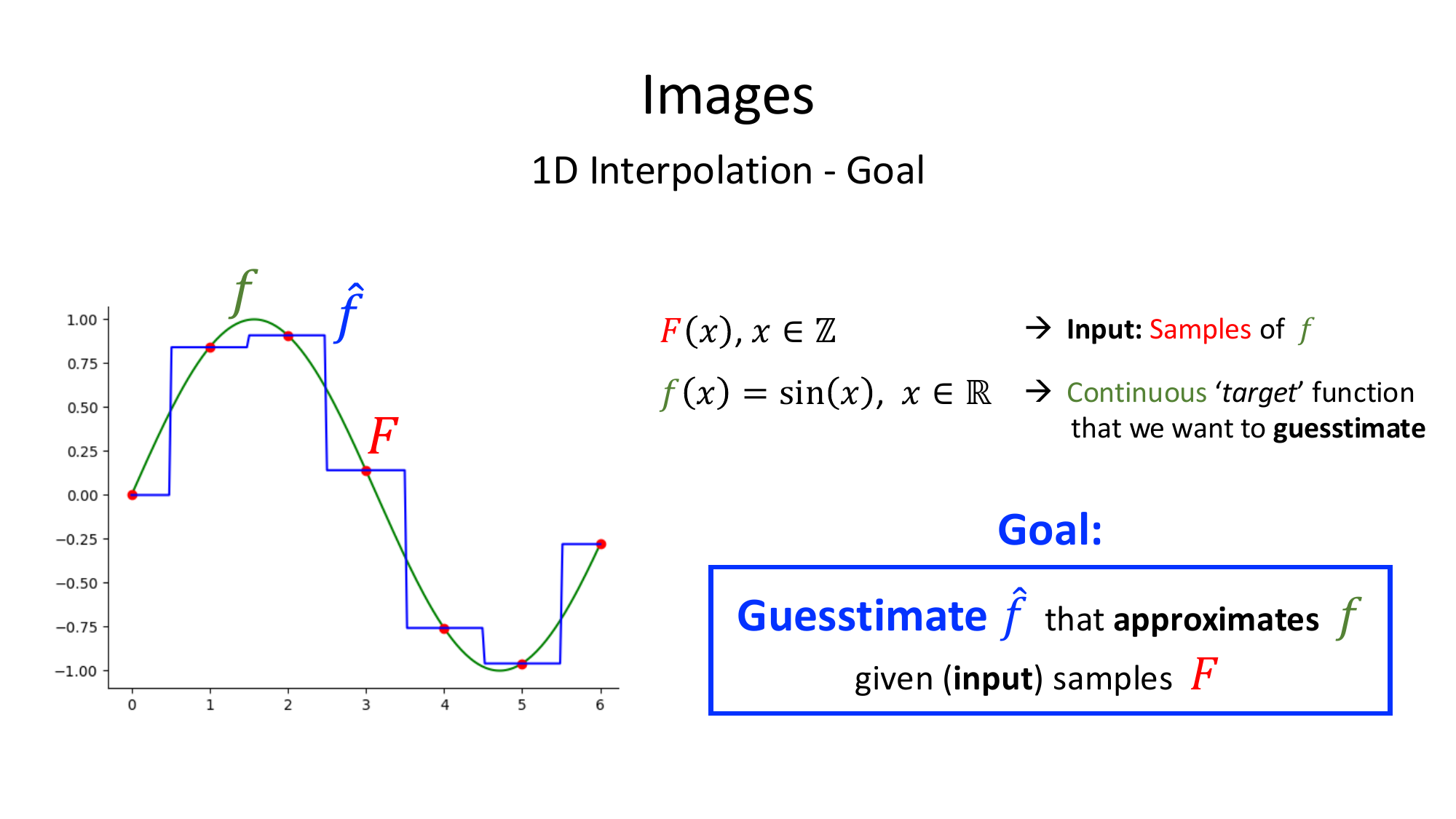
Rule
Nearest neighbor interpolation chooses the sample whose index is closest to :
This is basically rounding.
Example
If you know samples:
then:
Why it becomes a staircase
For many nearby values, the chosen sample does not change.
Example:
So the output is constant on that whole interval.
Constant interval + sudden jump + constant interval = staircase shape.
The handwritten notes explicitly connect this with the rounding rule:
round(x) == floor(x + 0.5)So nearest neighbor is really “round the coordinate, then copy that sample”.
Pros
- very simple
- very fast
- preserves exact sample values
Cons
- blocky
- jagged edges
- not smooth
Python
import numpy as np

F = np.array([2.0, 5.0, 3.0, 7.0])

def nearest_neighbor(F, x):
    k = int(np.floor(x + 0.5))
    k = max(0, min(k, len(F) - 1))
    return F[k]

for x in [0.1, 0.5, 1.2, 2.7]:
    print(x, nearest_neighbor(F, x))