university computervision week1 theory
Bilinear Interpolation
Source:
- HC1a Images and Interpolation
Idea
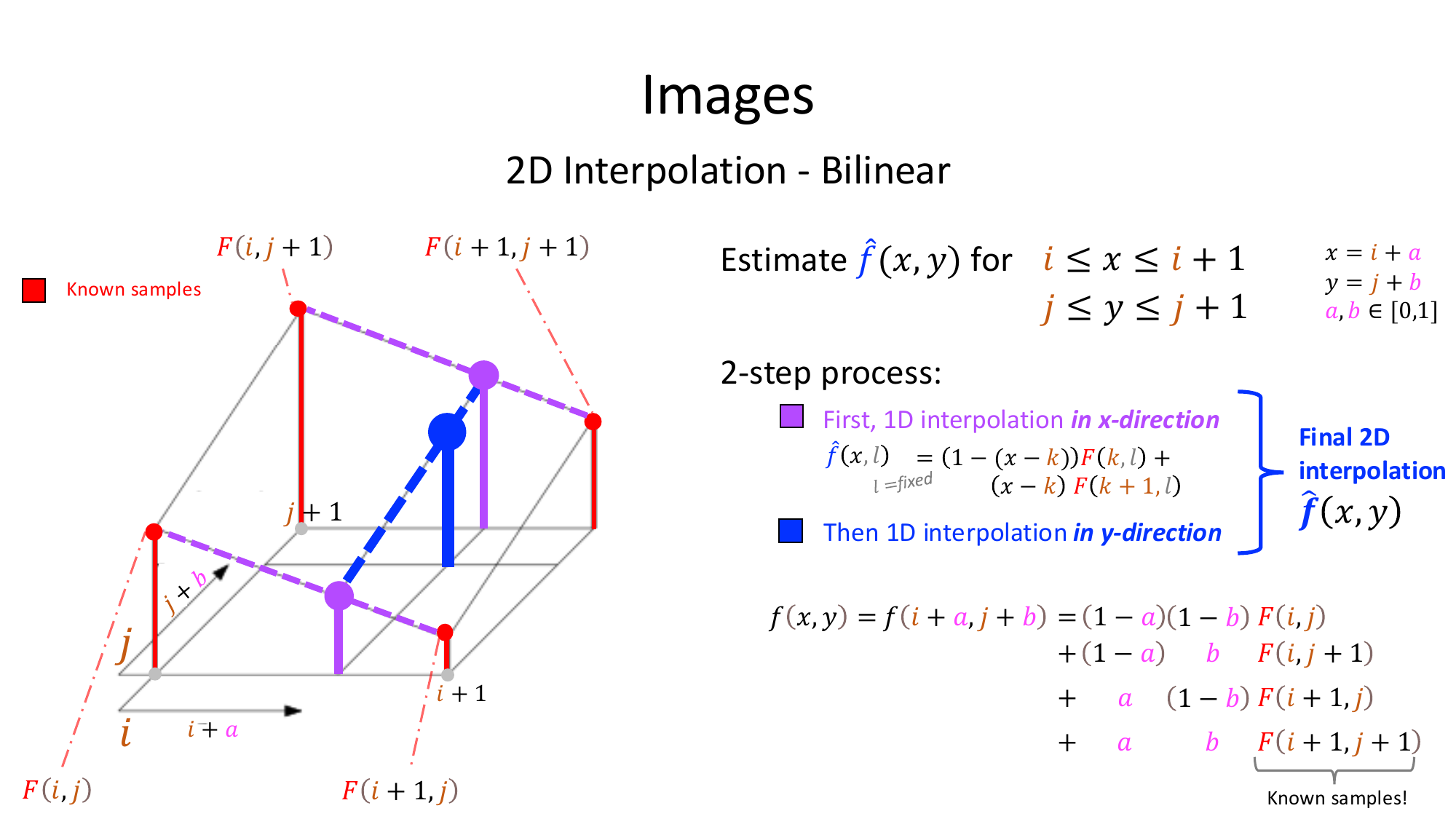
Bilinear interpolation is the 2D version of linear interpolation.
You have four known pixel values around a point:
and want the value at:
with
Formula
The lecture gives:
Easy meaning
Each corner gets a weight.
- closer corners get bigger weights
- farther corners get smaller weights
- all weights add up to 1
Two-step view
The easiest way to understand it:
- Interpolate horizontally on the top row
- Interpolate horizontally on the bottom row
- Interpolate vertically between those two intermediate values
So it is just linear interpolation done twice.
Why it is useful
This is common when:
- resizing images
- warping images
- reading image values at non-integer coordinates
It usually looks smoother than nearest neighbor.
Python
def bilinear(F00, F10, F01, F11, a, b):
    return (
        (1 - a) * (1 - b) * F00
        + a * (1 - b) * F10
        + (1 - a) * b * F01
        + a * b * F11
    )

print(bilinear(10, 20, 30, 40, 0.25, 0.5))